
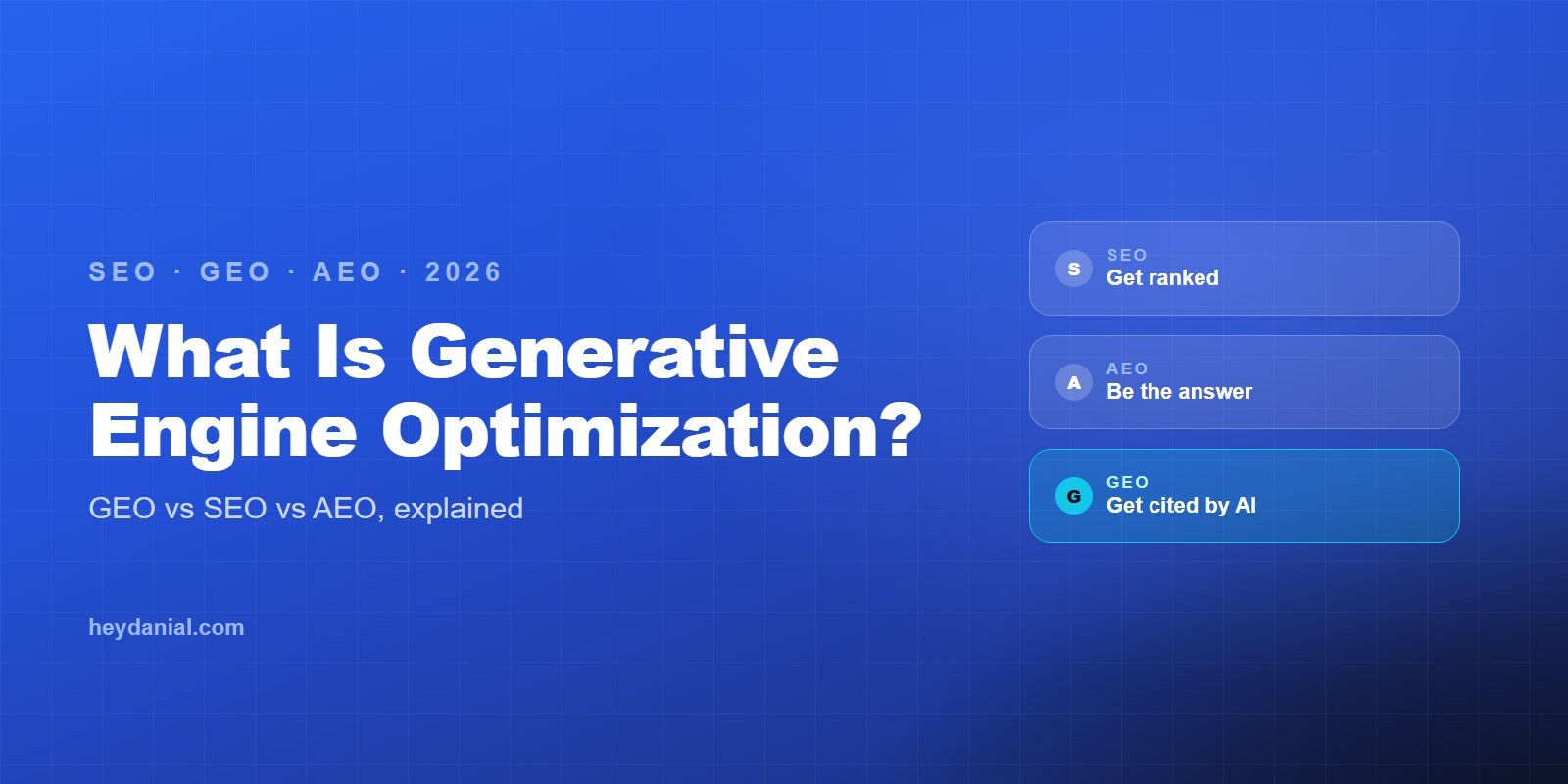
For twenty years, the goal of search marketing was simple: get to the top ten blue links. Now a growing number of searches end with an AI-written answer instead — in ChatGPT, Perplexity, Gemini, or the AI Overview at the top of Google. Those answers cite only a handful of sources. Generative Engine Optimization (GEO) is the work of making sure you're one of them.
This guide explains what GEO actually is (without the hype), how it compares to SEO and AEO, what the original research found, and a practical checklist you can apply to your site this week.
The short answer
- GEO = optimizing to be included and cited in AI-generated answers.
- It builds on SEO, not instead of it — AI tools pull their sources from search indexes.
- Research shows statistics, quotations, and cited sources raise AI visibility by up to 40%.
- The extra GEO layer: entity clarity, extractable answers, third-party mentions, freshness, and citation tracking.
What is generative engine optimization (GEO)?
Generative Engine Optimization (GEO) is the practice of optimizing your content and brand so that AI answer engines include and cite you in the responses they generate. "Generative engines" are tools that write an answer rather than list links: ChatGPT search, Perplexity, Google Gemini, Microsoft Copilot, and Google's AI Overviews and AI Mode.
The term was introduced in a 2023 research paper, "GEO: Generative Engine Optimization" by Aggarwal et al., later published at KDD 2024. The researchers built a benchmark of 10,000 queries and tested which content changes made a source more visible in AI-generated answers.
GEO vs SEO vs AEO: what's the difference?
SEO earns rankings, AEO earns the direct answer, and GEO earns a citation inside AI-generated responses. In practice they overlap a lot — here's how they compare:
| SEO | AEO | GEO | |
|---|---|---|---|
| Goal | Rank pages in search results | Be the direct answer | Be included and cited in AI answers |
| Where | Google & Bing results pages | Featured snippets, voice assistants, AI answers | ChatGPT, Perplexity, Gemini, AI Overviews |
| Success metric | Rankings, clicks, traffic | Snippet / answer ownership | Citations, mentions, share of AI voice |
| Key levers | Keywords, links, technical health | Question-based content, schema | Evidence, entity clarity, mentions, freshness |
One honest note: Google's position is that there's no separate trick for its AI features — the same SEO best practices apply. That's why I treat GEO as a layer on top of SEO, not a replacement. If search engines can't find and trust you, AI won't cite you.
Why GEO matters in 2026
AI answers now sit above or replace a large share of traditional clicks, so being cited is becoming as important as ranking. A few data points (mostly from industry tools, so treat them as directional):
- AI visibility platform Peec AI reports Google AI Overviews appeared on 86.7% of business-intent searches in April 2026, up from 56.9% a year earlier.
- Ahrefs data indicates the click-through rate of the #1 result drops sharply when an AI Overview is shown.
- Meanwhile, AI tools are sending real referral traffic — and visitors who arrive after reading an AI answer have usually already been "pre-sold" on the source.
The takeaway: you still need to rank, but the brands that win the next few years will be the ones AI names.
What the research says actually works
The original GEO study found that adding citations, quotations, and statistics was among the most effective ways to raise visibility — by up to 40% across queries, and up to 37% when tested on Perplexity. Other findings worth knowing:
- Evidence beats fluff. Content with specific numbers and credible sources was cited more than content that only sounded authoritative.
- Keyword stuffing doesn't help. The old SEO trick of repeating keywords performed poorly in generative engines.
- Results vary by topic. What works in health or law differs from what works in marketing or tech — test in your own niche.
The 7-part GEO framework
This is the framework I apply to client sites (and to this one). Each part maps to how AI tools find, read, and trust sources.
1 — Entity clarity
AI needs to know exactly who you are. Use the same name, title, and description everywhere — website, LinkedIn, directories, social profiles. Add Person or Organization schema with sameAs links connecting all your profiles. Ambiguous brands get skipped.
2 — Crawlability for AI
Allow the AI search crawlers and serve content in plain HTML. Keep OAI-SearchBot, PerplexityBot, Googlebot, and Bingbot allowed, get indexed in Bing as well as Google, and make sure your text isn't hidden behind JavaScript. (Step-by-step in How to get cited by ChatGPT & Perplexity.)
3 — Extractable answers
Write sections an AI can quote on their own. Question-shaped headings, a direct answer in the first sentence, then the explanation. Use tables for comparisons and numbered lists for steps.
4 — Evidence
Back every important claim with a number, a source, or a quote. First-hand data is the strongest evidence of all — it's why I publish real results in my case studies instead of generic promises.
5 — Third-party mentions
AI trusts what other trusted sources say about you. Get featured in industry roundups, podcasts, guest posts, review platforms, and genuinely helpful Reddit or LinkedIn discussions.
6 — Freshness
Update your most important pages every 90 days. Refresh statistics, examples, and the visible "last updated" date (and dateModified in your schema).
7 — Measurement
Track a fixed list of customer questions across AI tools every month. Log whether you're cited and which page, watch referral traffic from chatgpt.com and perplexity.ai, and watch branded search growth in Search Console.
GEO checklist
| Check | Done when… |
|---|---|
| Entity schema | Person/Organization schema with sameAs links is on your homepage |
| AI crawlers | OAI-SearchBot, PerplexityBot, Googlebot, Bingbot allowed (robots.txt and firewall) |
| Bing indexing | Site verified in Bing Webmaster Tools, sitemap submitted |
| HTML content | Main text visible in page source without JavaScript |
| Answer-first sections | Every H2 opens with a direct one-sentence answer |
| Evidence | Key claims have numbers, sources, or quotes |
| Schema | Article + FAQ schema on posts, validated in Rich Results Test |
| Mentions | At least a few new third-party mentions per quarter |
| Freshness | Top pages refreshed within the last 90 days |
| Tracking | Monthly AI citation log in place |
GEO myths to ignore
| Myth | Reality |
|---|---|
| "GEO replaces SEO" | AI tools pull sources from search indexes. Weak SEO means weak GEO. |
| "You need llms.txt to appear in AI" | llms.txt is an optional proposal. Google ignores it, and it's no substitute for crawlability and good content. |
| "Blocking Google-Extended removes you from AI Overviews" | Google-Extended controls Gemini training and grounding — AI Overviews are part of normal Search. |
| "Just write more AI content" | Generic content is exactly what AI skips. Evidence and first-hand experience win. |
Key takeaways
- GEO is about being cited in AI answers — and it stands on top of solid SEO.
- The research is clear: statistics, quotations, and sources raise AI visibility.
- Work through the 7 parts: entity, crawlability, extractable answers, evidence, mentions, freshness, measurement.
- Start with the checklist, then track citations monthly. For Google specifically, read how to rank in AI Overviews.
Frequently asked questions
What is generative engine optimization (GEO)?
Generative Engine Optimization (GEO) is the practice of optimizing your content and brand so AI tools such as ChatGPT, Perplexity, Gemini, and Google AI Overviews include and cite you in their generated answers. The term comes from a 2023 research paper by Aggarwal et al., published at KDD 2024.
What is the difference between GEO, SEO, and AEO?
SEO aims to rank pages in traditional search results. AEO (Answer Engine Optimization) aims to be the direct answer, such as featured snippets, voice answers, and AI answers. GEO aims to be included and cited in AI-generated responses. They overlap heavily: GEO builds on solid SEO rather than replacing it.
Does GEO replace SEO?
No. AI tools retrieve sources from search indexes, so if you don't rank or aren't indexed, you are rarely cited. Google itself says optimizing for its AI features relies on the same SEO best practices. Think of GEO as an extra layer on top of strong SEO.
How do I measure GEO results?
Track a fixed list of customer questions in ChatGPT, Perplexity, and Google every month and log whether you're cited. Also watch referral traffic from chatgpt.com and perplexity.ai, branded search growth, and AI-visibility tools if you have the budget.